
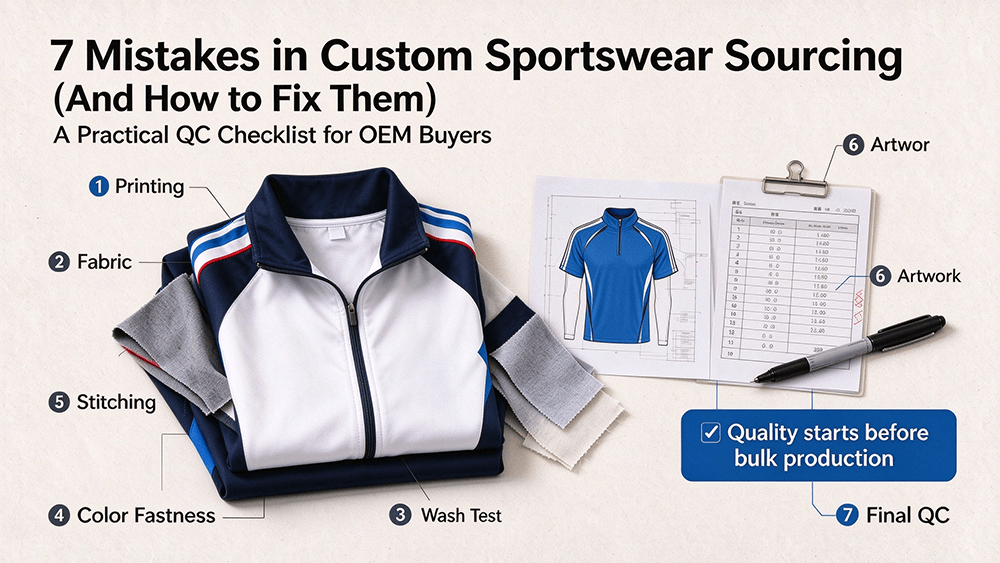
Custom sportswear sourcing mistakes often lead to disappointing results when you order custom team kits or branded activewear from an overseas supplier, you’ve probably been here.
You sign off on a sharp-looking sample, pay for the bulk run, wait weeks for delivery… and after just 3 or 4 washes, the logo cracks, the numbers peel, the colors go dull, or the whole garment shrinks a full size.
It’s frustrating, it’s costly, and it makes you look bad to your team or your customers.
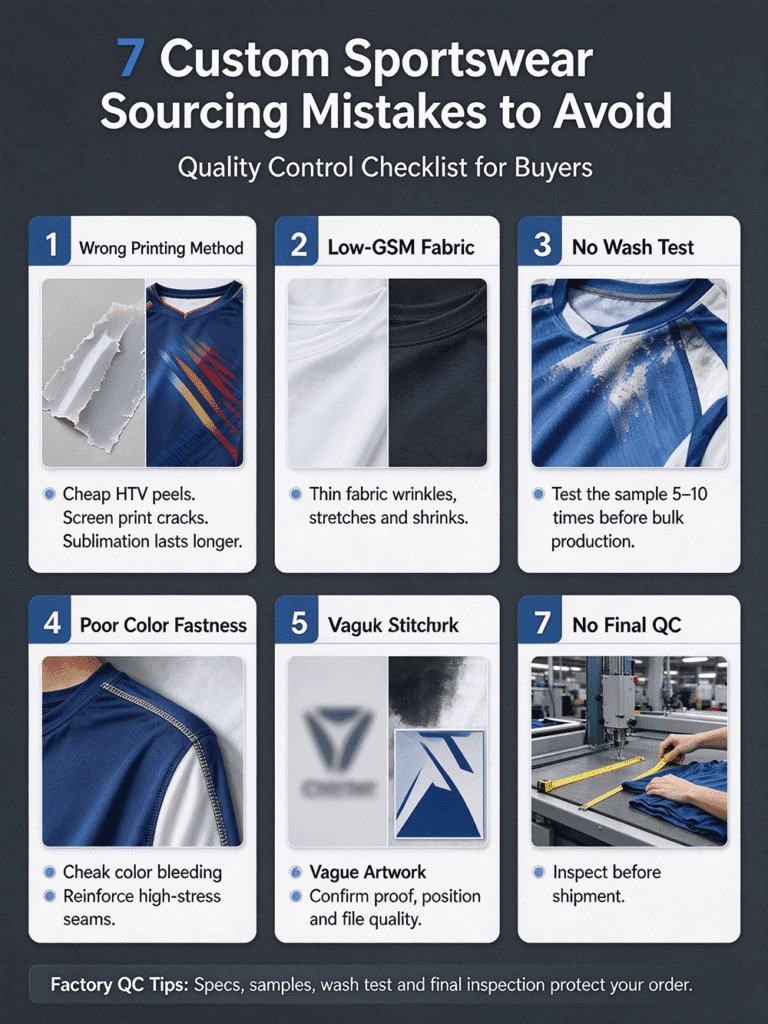
Most of these quality disasters aren’t bad luck. They come from small, totally avoidable mistakes made during the sourcing process. Here are the 7 we see all the time, and exactly how to steer clear of them.
Understanding these custom sportswear sourcing mistakes helps buyers set clear quality requirements before production.
1. Custom Sportswear Sourcing Mistakes: Picking the wrong decoration method
Screen print and cheap heat transfer vinyl look crisp when they first arrive. But they don’t hold up to repeated washes, tumble drying, and the rough and tumble of actual sports.
- Budget heat transfer vinyl: usually starts peeling after 5–15 washes, especially on stretch fabric
- Standard screen print: cracks over time, stiffens the fabric, and fades with sun exposure
- Dye sublimation: ink bonds directly into the polyester fibers, so it won’t peel, crack or fade even after dozens of washes
For soccer jerseys, running kits and high-wear activewear, sublimation is almost always the most durable long-term call. A lot of low-cost factories will default to cheap heat transfer without asking — so always specify what you want upfront.
2. Skimping on fabric weight and quality
There’s a reason some suppliers quote 30% less than everyone else. More often than not, they’re cutting corners on fabric.
Thin, low-GSM polyester doesn’t just feel cheap — it wrinkles easily, holds sweat, and can shrink unpredictably after the first wash.
Always lock in fabric weight (GSM), composition, and performance features (like moisture wicking) before you confirm the order. Don’t just go by how the sample feels — get the specs in writing.
3. Not running a wash test on your pre-production sample
A sample can look perfect hanging on a hanger. That doesn’t mean it will hold up in real life.
Before you green-light bulk production, throw the sample in the wash 5–10 times. Check for:
- Color bleeding onto white panels or skin
- Peeling or cracking logos and numbers
- Shrinkage in length or width
- Loose stitching or unraveling hems
It adds an extra week to your timeline, but it saves you from receiving a full order of unusable garments.
4. Overlooking color fastness
This one flies under the radar for a lot of new buyers.
Deep, saturated colors look great on a screen, but low-grade dye will bleed onto other clothes in the wash, or even transfer onto skin during a sweaty game.
If color stability matters for your design, ask for color fastness test results upfront. Reputable factories will have this data ready to share.
5. Weak stitching on high-stress seams
Sportswear gets pulled, stretched and washed constantly. Flimsy stitching on shoulders, side seams and cuffs will blow out sooner or later.
Look for reinforced stitching on all high-tension areas. It’s a tiny detail that adds almost nothing to cost, but makes a huge difference in how long the garment lasts.
6. Vague artwork files and placement notes
Blurry logos, wrong file formats and unclear placement instructions are one of the most common causes of misprinted bulk orders.
If your artwork is low-res, off-center, or uses the wrong color mode, what comes off the production line won’t match what you saw on screen.
Always confirm a digital artwork proof before mass production starts. It takes 5 minutes and prevents a whole lot of headaches.
7. Skipping final QC before shipment
Samples can pass every test. Bulk production can still have inconsistencies.
A final pre-shipment quality check catches misprints, stitching errors and size mismatches before the goods leave the factory. It’s far cheaper to fix issues on the factory floor than it is to ship defective goods all the way to you.
Many buyers overlook these custom sportswear sourcing mistakes before mass production, only to discover quality defects after receiving finished garments.
How we handle this at Tensuit
We’ve been making custom sportswear for over 18 years. We’ve seen every one of these mistakes cost buyers time, money and clients.
That’s why we build all these checks into our standard process:
- Dye sublimation as standard for all full-print soccer jerseys
- Clear GSM and fabric spec sheets for every order
- Pre-production samples with wash test support
- Reinforced stitching on all high-stress seams
- Full QC pass before any order ships
- Flexible MOQs for small teams and new sportswear brands
If you’re tired of ordering custom sportswear that falls apart after a few washes, reach out. We’ll walk you through exactly what to expect — no hidden surprises.
Knowing these common custom sportswear sourcing mistakes can help you avoid costly quality failures for your custom apparel orders.
If you need reliable custom sportswear, check our custom football jersey options.